Tuesday, January 11, 2011

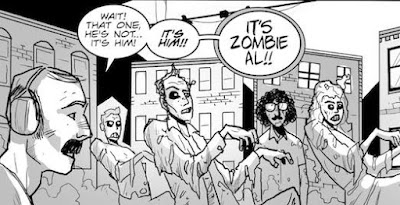
Q&A with Fubar's Jeff McComsey, part 2


Today I'll finish up my conversation with Jeff McComsey, man of many talents who also has a great looking beard.  Seriously, he must have started growing that thing years ago.

You can read the first part of this question-and-answer session here!


McClelland: As a writer/artist, you might look at the creation process a bit differently than someone who just does one or the other.  Do you ever draw first with the intention of adding dialogue later?  What differences do you notice with your style when drawing from someone else's script as opposed to being in control of the entire process?

McComsey: I like to switch up between working from my own writing to someone else’s finished scripts.  Sitting down and banging out a little short story by myself is very satisfying but I find that good comic writers know how to move a story a lot better than I do when I kind of make it up as I go along.  My stuff tends to meander along when I write my own stuff. 


McClelland : What do you enjoy about working from some else's script?


McComsey: I love different peoples' pacing from panel to panel. I know that working from a script usually has me stretching away from my comfort zone more often than when I just roll with my stuff.

McClelland: Who are some of your artistic influences in the comic industry (or otherwise)?

McComsey: I’m a big fan of British writers and artists. 2000AD is a personal favorite of mine. I love guys like Dave Gibbon, Colin Wilson and Garth Ennis.  I constantly find myself inspired by my small press brothers and sisters who have been turning out some excellent work.

Film is a big influence, particularly when I’m composing a shot. Older films are great sources of reference on how to frame shots and stage lighting.


McClelland: What are your thoughts on sandwich meat?  Do you have a favorite and why?

McComsey: I like a good sandwich. I like deli ham sliced very thin. That’s the key. I feel like the flavor and texture are much nicer when it’s thinly sliced. I find the older I get the spicier I like my Deli meats.  The other key to a good sandwich is good bread/roll.

McClelland: Feel free to use this last question to sell a potential reader on FUBAR.  What should they expect?  Why should they buy it?  Where can they get it?  WILL THERE BE ANOTHER?!

McComsey: FUBAR has something for all comic fans. If you like zombie books, you’ll like FUBAR. If you love World War II comics, you’ll love FUBAR. If you love indie comic art, you’ll love FUBAR. It’s 15 short stories that collect into a 184 page book for $12.00. I feel that FUBAR contains some work from guys and girls who will be prolific creators in the near future worth keeping an eye on.  FUBAR is available at your local comic shops or online via amazon.com or through Barnes and Noble.  We will be releasing a second volume of FUBAR in the early fall of 2011. Stay tuned!


Many thanks for Jeff for answering all of my weird questions...especially the one about sandwich meat, which was actually pretty interesting now that I read the whole thing again.  I'm more of an oven-roasted turkey guy myself, all things considered.

Be sure to pick up volume one of FUBAR from your local comic shop or from Amazon.com, and check out Jeff's websites here and here!

Sunday, January 9, 2011

Ted sketch cover by Ron Frenz!


I got this piece of artwork in the mail a few weeks ago and just got it scanned in - several things are obvious about it.  First, it's a drawing of Ted.  Second, it's in the distinctive Ron Frenz style (another clue is the "Ron Frenz" signature on the bottom right).  Third, it's similar to Joe Sinnot's Yeti cover.  Fourth, IT'S AWESOME.

Ron is an industry pro with too many credits to list, though he might be most well known for designing the "electric blue" Superman costume.  If memory serves, he's also the first to draw Spider-Man in his black costume in the pages of Amazing Spider-Man.  Like Joe Sinnott, Ron has made important contributions to the Fantastic Four over the years.  Unlike Joltin' Joe, Ron's a Pittsburgh guy like me, which makes working with him an extra treat - not to mention he's been one of the nicest guy's I've worked with.

I originally had plans to run Joe Sinnott's Yeti sketch as the "B" cover to issue #4; I might switch that one out with this and move the Yeti to #5 (just because of positioning and because, well, Ted is listed first in the title).  We'll see.  Either way, they make great images and have a "bookend" feel to them.

Saturday, January 8, 2011

"Many Man" sketch card by Danny Cruz


Danny Cruz, while at the Wagon Wheel Comics booth at the New York Comic Con, drew a handful of sketches on sketch cards from the Teddy and the Yeti trading card set.  This is one of 'em, and if I'm remembering correctly, it might be the only one on which he drew an actual character from Teddy and the Yeti (a popular option: "draw me!").

The character on this card...what was his name...it's right there...oh well, I'm sure it'll come to me at some point.  But I finally got a scan of this and I had to share it.  It's a great piece of art and it's awesome to see!

Friday, January 7, 2011

"Eye of the Beholder" webcomic with Ruben Cordero, page 8


Here we are at the end of this particular story.  Yes, it's a sad occasion, but weep not - I write other stuff, too.  Like Teddy and the Yeti.  You should totally buy it.

And speaking of shelling out good money for things with my name attached them, "Eye of the Beholder" is published in the collection Strip Search from Dark Horse Comics.  This book is available at lots of places, like Amazon (click on the links!), Things from Another World, Mile High Comics, Midtown Comics, heck...if you give 'em the ISBN (1593070993), big stores like Barnes and Noble will order it for you!

I'm really lucky to have been a part of this project, and I can't thank talented individuals like editor Adam Gallardo and, of course, artist Ruben Cordero, who is a heck of an artist and a heck of a guy, enough for everything they did to bring this dream to life.  This is the story that convinced me to try to make comics on a semi-regular basis, and I'm thankful for the opportunities it's granted.  May everyone who wants one have their own "Eye of the Beholder".

I'll post some "extra" stuff in a few days - character designs, sketches, pages in progress, etc. - things that haven't been published before.  It should be a fun way to wrap this short story up.

Thursday, January 6, 2011

Is "Fred and Barney Meet the Thing" as bad as it looks?


I think it's fairly common knowledge that I love the Thing.  I love him.  I do!  There's so much that's great about a character like Ben Grimm.  Even though this is true, however, I've never seen the 1970s cartoon "Fred and Barney Meet the Thing".  One reason I've never seen it is that I wasn't alive in 1979.  Another is that repeats are aired almost never.  Another is that it looks like one of the most horrible shows ever made.


Despite how funny it is to see a shark bite the Thing then row away on dry land after its teeth fall out, I wonder who thought that it would be a good thing to partner up the Flintstones with a teenage version of Ben Grimm.  The characters never crossed over during the program - the show featured two 11-minute Thing cartoons followed by an 'updated' Flintstones episode - which is strange, seeing how the intro would lead you to believe the characters all went on adventures together.

Was it just because of the rock corollaries?  The fact that the Thing is made of stones and everything in the Flintstone universe obsessively HAD to use some sort of stone reference (James Darren is guest starring in this episode?  CALL HIM JAMES DARROCK!)?  That's the only half reason I can come up with.

Every once in a while, Cartoon Network's "Boomerang" channel will air an episode or two of the Thing cartoon.  I don't get Boomerang, and thus I haven't see the show.  But if it's anything like this, I might be glad that I'm not able:


Why is the Thing a teenager?  Why does he have "Thing rings"?  Why does he lose his Brooklyn accent when he transforms into "Benjy"?  And perhaps most importantly, why the heck doesn't he just move the truck stuck on the tracks rather than running headlong into a speeding train?

...there's still a good chance I'd buy this if it was ever released on DVD.

Monday, January 3, 2011

"Eye of the Beholder" webcomic with Ruben Cordero, page 7


Here we are with page seven of "Eye of the Beholder" - one more page to go and the suspense is at its height.  I certainly went with "religious fury" with this story, didn't I?  There's even a "Kraka-DOOM!" sound effect!

Strip Search isn't only my first comic book publication, but also perhaps my best reviewed work to date. A hundred years ago, I wrote about how reviews are tough to come by for me and what I write (for whatever reason), but Strip Search was reviewed by none other than the American Library Association, which, even if you've never heard of it before, sounds pretty official.  I didn't read the review until several years after the book was released (way to keep up on it, Jeff), but I was still taken back when I did.  Here's what the ALA had to say in their publication, "Booklist":
After the plug was pulled on the anthology series Dark Horse Presents, editor Gallardo found himself griping about where emerging artists were going to get their first exposure. So he started up a Web-based version of DHP, and here he presents the cream, according to site visitors, of what he put up on the site monthly, July 2002-June 2003. Pretty obviously, the genre won't run out of artistic talent any time soon. The Brownlee brothers' faux photographic style and Steve Morris' gorgeously manipulated and photographed models may be the most technically adroit stuff on view, but the other contributors' highly varied drawing styles are just as impressive, whether in color or black and white. The story element is frequently rather thin, however, and many may give best story honors to Jeff McClelland and Ruben D. Cordero Jr.'s straightforward inversion of Hansel and Gretel. All the others beg for more development, which makes the collection's point that each of these newcomers could reward a much longer look at his or her work. -- Ray Olson 
Copyright © American Library Association. All rights reserved
 Let me highlight the interesting part of that review, just to make sure no one missed it: "...many may give best story honors to Jeff McClelland and Ruben D. Cordero Jr.'s straightforward inversion of Hansel and Gretel."  Wow.  I have no idea who you are, Ray Olson, but what a nice thing to say.  I'm still not sure what I did to deserve it, but I'll take a compliment where I can get one, without a doubt.

Saturday, January 1, 2011

Q&A with Fubar's Jeff McComsey, part 1


How many times have I promoted the WWII/zombie anthology FUBAR (now on sale!) on this blog?  The answer: NOT ENOUGH!  Not only does this collection contain a certain short story by myself and Leonardo Pietro, but it's masterminded by the inimitable Jeff McComsey.  After meeting Jeff at April's Pittsburgh Comicon, it was easy to see that he was a strong voice in the independent comics scene.  It was there that I picked up a copy of his American Terror graphic novel, and I've been impressed by everything he's done since.

Jeff was kind enough to type out some answers to the many questions I recently asked him.  Normally I designate who is speaking during these Q&A sessions with their initials; that's a problem this time around.  I guess I'll write out last names.  That would work.  Whatever.


McClelland: In my opinion, the comics field has changed a great deal in the last 20 years, in that there appears to be greater diversity but a dwindling base of readers.  Maybe I think that because I'm more aware of different books than I was at, oh, age nine, but it seems there's more choice if someone wants to read something different.


How do you react to that as an independent creator?   Do you have more opportunity in today's market with the gradual acceptance of graphic novels in mainstream culture?  Do you still have to worry about reaching potential readers with comic readership declining since the days of the Death of Superman storyline?


McComsey: I do feel like sometimes that I missed the black and white boom that TMNT brought out in the mid 1980s to the early 1990s.  As a guy who does almost exclusively black and white, that would have been nice. It’s still tough to get a book distributed through comic shops with Diamond’s benchmark and the fickleness of most shop owners, though. What I have found is that it seems like conventions are getting better traffic than they used to.

FUBAR, for example, was able to finance its various print runs by selling books at conventions. While the numbers buying from shops are shrinking it seems more folks are willing to shell out for a book they like at a con or to attend them in the first place. It’s similar to what musicians have encountered since downloading/piracy has taken a huge bite out of album sales. If the band wants to make money they have to tour.  

As an indie creator, the con circuit is crucial for turning any profit at all or promoting a project. They’re also a bunch of fun and great opportunities to meet other cool creators like yourself.

McClelland:  What is it about horror comics that appeal to so many readers?  Ten years ago, I don't know if there were more than a half dozen dedicated horror-themed books on the shelves, and now they seem to be all over.

McComsey: Horror comics in particular is a genre that comes and goes.  It, along with stuff like war and romance comics, was there at the birth of the medium and never vanishes for very long.


As a creator, horror/zombie books are extremely fun to draw and write, and I think most creators given the opportunity jump at the chance of testing their mettle in a genre that has had stellar work done by those who came before us.


McClelland: What was the switch that all of sudden turned 'on'?


McComsey: I think one of the reasons for the sudden resurgence of horror books is the fact that most horror tropes are well known amongst readers. You can pick up a stray zombie/horror comic and already know more or less what you need to know to enjoy it, unlike most mainstream comics where there is a built in continuity that either you’re familiar with or you’re not.


McClelland: FUBAR includes over a dozen creators on its various stories.  How difficult is it to coordinate all of the different creators in an effort to form a cohesive project?

McComsey: I think the trick is to take it one step at a time.  Find writers to write stories, then find some artists to draw them.  About a million emails later and you’ve got a book. With the story side of these operations I had help in the form of Jorge Vega.  Jorge is a writer friend who I’ve worked with a bunch and I trust his objective assessment of material.  Along with his organizational skills, Jorge was a huge help in the first stage of FUBAR.

McClelland: What challenges do you face from an editorial standpoint?

McComsey: When it comes to collecting/editing the art, I am very used to that process and understand what it’s like to contribute to a book like FUBAR when there’s no pay and even the book being published can’t be guaranteed.  It was important for me not to “bug” contributors, but to keep people excited for the book and help everybody knock out stellar work that they’ll be proud to show off.

While having so many contributors made it tricky to initially put the book together, it was the biggest help when it came time to promote FUBAR.  That also means over a dozen guys and girls posting to Facebook and their respective blogs spreading the word.


I'll stop there and pick up in a few days.  Check out more of Jeff's work here: http://mccomseycomix.wordpress.com/ and here: http://zombiefubar.wordpress.com/.  You can buy a copy of FUBAR: Volume 1 at any comic shop or through Amazon.com.