FUBAR: Empire of the Rising Dead hits comic book stores next month, at which point everyone can stop listening to me rail on and on incessantly about this World War II zombie anthology and go buy a copy for themselves, afterwards I will probably begin railing incessantly about the quickly developing volume three. One thing at a time, though.
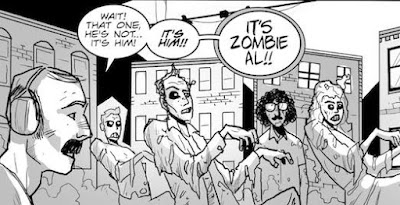
I recently chatted with FUBAR Commander-in-Chief Jeff McComsey, the brains behind this undead operation, and below are the results of this session, interspersed with preview pages from the new collection of stories from writers and artists from around the world. In this interview, McComsey announces that while the book ships from Diamond to stores in mid-December, there will be a nationwide signing event taking place on January 7th, 2012. As I mentioned a little bit earlier, I'll be signing copies of this book at Pittsburgh Comics on this day, a Saturday.

McClelland: Even though I got involved with FUBAR at
the tail end of volume 1, it's still been interesting for me to see the notable
growth of the concept between then (early 2010) and now with volume 2.
How has the concept of FUBAR changed between its inception and what it is
now?
McComsey: The concept as far as it being a World War 2 zombie anthology has stayed pretty much the same. What has changed is its size. We went from roughly 17 contributors in volume one to roughly 40 creators for volume two. The scale of the project has been for me an immense source of pride for me. Through this monster I've gotten to work with a veritable army of Small-Press Commandos. I think we were all waiting for a project and FUBAR just happened to be it.
McComsey: The concept as far as it being a World War 2 zombie anthology has stayed pretty much the same. What has changed is its size. We went from roughly 17 contributors in volume one to roughly 40 creators for volume two. The scale of the project has been for me an immense source of pride for me. Through this monster I've gotten to work with a veritable army of Small-Press Commandos. I think we were all waiting for a project and FUBAR just happened to be it.
McClelland: What's been the
reaction to FUBAR so far, and how has that reaction shaped the development of
FUBAR in its current state?
McComsey: The creators involved have been consistently
gung ho about helping finish and promoting this project. We do a lot of
conventions with this book and the reaction has been phenomenal, [especially] after doing
the handful of cons that FUBAR attends and seeing that we have some legitimate
fans. I always say this will be the last volume until we get the book out for
sale and the reaction always has me immediately planning the next.
McClelland: We're dealing with
a fictional universe filled with zombies - on the surface, anyway, this isn't
something that hasn't been been done before. How do you find a way to craft stories that make the tried-and-true idea of the dead come back to life
fresh and vital again? Is there a formula for success when it comes to
zombie stories?
McComsey: There are, for me, two types of stories we
do in FUBAR. First, there are the stories that are meticulously researched and
carry the seriousness and respect due the grim subject matter of World War 2.
The second are completely bat-shit crazy seat-of-your-pants style WW2 zombie
bashing tales, reminiscent of "Inglorious Basterds". If submitted stories fall
anywhere in those two neighborhood, I’m a happy camper.
McClelland: For the most part,
the stories in volume 1 seem to be contained within their own pages - that is,
I didn't get the idea that these stories shared the same "space".
The first story in volume 2, though, seems to imply at least a basic
cohesion, or at least a link between volumes. Do the stories of FUBAR
vol. 2 share the same "universe" as that of vol. 1? Should they? Are these
stores best considered as individual pieces or part of a larger whole?
McComsey: I wrote the first
story as a kind of bridge between the two volumes, but overall, the stories all
exist in their own universes. In the first volume we had a rough timeline for
the outbreak, but with the nature of the Pacific Theater of WW2, a timeline would have been problematic, so we opened the entire conflict to the writers.

McClelland: What are some of your
favorite stories from volume two, and what should readers look forward to when they
pick up the book in December?
McComsey: It’s hard to say for
me. I’m very proud of the short that Jorge [Vega] and I did called “Wild Blue”. Jim McMunn
illustrated not one, but three shorts in this volume. Those are some of my
favorites. The thing that fans of the first volume will dig is that this book
has over 100 more pages than the first volume. This second volume is
absurdly huge.
McClelland: FUBAR has made a number of convention stops in the past months. What appeals to you about setting up at a con?
McComsey: I love doing conventions. We go all out for the booth set up, and
watching it draw people in is always amazing to see. That combined with the
sketches we do in the front of the books for the people who buy them makes my
FUBAR con experiences very memorable.
McClelland: You've put out word of a big signing event at various points around the country when the
book is released. What
stores are you planning on visiting when this book goes on sale?
Yes, we are organizing
a large signing event for January 7th at several shops across the
country. I will be at "Comic Book Jones" on Staten Island holding it down with my
partners in crime, Dominic [Vivona] and Steve [Becker].

McClelland: Lastly, here's a random question that nevertheless demands and answer: who was/is your
favorite Ninja Turtle and why? WHAT IS THE SECRET OF THE OOZE?!?
McComsey: That’s a toughie. I clearly
remember being a Raphael fan. His weapons were the worst but he was a smartass
and somehow as a kid that endeared him to me. The secret of the ooze is that
while it looked awesome in the JC Penny’s catalog, your parents were way too
smart to give you a pile of viscous neon green snot substance for Christmas.

Many thanks to Jeff for putting up with some of my more asinine questions for the second time. To learn more about FUBAR: Empire of the Rising Dead, go here: http://zombiefubar.wordpress.com/



 Posts
Posts