Friday, June 25, 2010

Futurama: Rebirth


Last night marked the epic return of Futurama to television in episodic format...and I loved it.  Please, Comedy Central...renew this show for a thousand more episodes.  Please.

Wednesday, June 23, 2010

Attention Earth: "Weird Al" Yankovic now owns a copy of Teddy and the Yeti


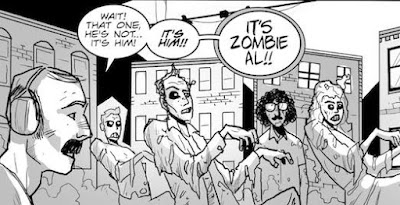
"Weird Al" Yankovic has been one of my icons since the sixth grade, when I was exposed to his "Greatest Hits" album for the first time.  Since then I have been lucky enough to meet the man a few times, and each time I come away a little star struck.  This is probably because he's not only the greatest comedy artist of all time, but also because he always comes across as a very down-to-earth, rather easy-going guy.

One of the first times I met him was about ten years ago at a concert at Penn State University.  I brought along with me a copy of Spider-Man Unlimited #1 to give him, part of the much maligned "Maximum Carnage" crossover (though it made a pretty good video game, if I'm remembering correctly).  The first page of this story features the Spider-Man villain Carnage subdued and being wheeled out to...who knows, prison or something.  The character proceeds to sing a violent parody of "Here Comes the Bride", to which one of the guards responds "You're a regular 'Weird Al' Yankovic, Kasady.  Emphasis on the 'weird'!"  Then Carnage kills a lot of people, as he's known to do.

Al really seemed to appreciate getting to see a reference to himself that he was otherwise unaware of (either that or he was really good at faking it), so this time around, on a concert trip to Atlantic City, I brought with me a copy of 2006's Friendly Neighborhood Spider-Man #13, which interestingly enough had a reference to none other than Harvey the Wonder Hamster, the oft-referenced Weird Al character who even got his own song on the "Alapalooza" album.  Yes, another Weird Al reference in a book featuring Spider-Man (with art by Todd Nauck, who drew the Mr. Massive cover to Teddy and the Yeti #2, no less).  It's a strange coincidence.


Because I couldn't pass up the opportunity, I stuck a copy of Teddy and the Yeti #1 on the other side of the bag and board, and we chatted about it briefly.  I have no idea if Al will flip through it - I know he's said that he grew up on Mad Magazine rather than comics.  He might take both books and toss them off a cliff for all I know.  But for one fateful moment, I was talking about Teddy and the Yeti with "Weird Al" Yankovic.  I'm having a hard time wrapping my head around that.

If you ever get the opportunity, check out a Weird Al concert.  It's got an energy that tops any other show I've ever been to.  Sure, I'm biased, but I think that his shows are the greatest you'll ever get a chance to see, with the many costume changes, video clips, audience interaction and overall showmanship he and his band bring to the stage.  Even if the last song of his you've heard is "Eat It", you'll come away feeling like you got your money's worth and more.  Trust me.

Here's a shot of him that I got during the show.  I'm thinking of framing it.

Thursday, June 17, 2010

Q&A with Paul Little, part 1


Paul Little has big talent.  (DID YOU SEE THAT ONE COMING, PAUL?!)  This prodigiously skilled colorist has not only lent his time to recent issues of Teddy and the Yeti, this Niagara Falls, Canadian artist also works on such titles as Image's Bomb Queen and Dynamo 5.  Paul was kind enough to answer a few questions about his work, the industry, and, rather randomly, one of the television shows I've been catching up with recently.

Below is the first part of the interview - I'll publish the second at a later date.  So, without further ado, Paul Little!

JM: It seems that colorists don't always get the credit they deserve when it comes to artistic involvement - and I mean that literally as well as figuratively. Very rarely do I ever see a cover colorist get his or her name in print, where the pencil and ink artist will always be credited. Why do you think colorists are so late to this party?

PL: There's a really interesting argument brewing over which party is more integral to the look of a given comic book in the modern era: the inker or the colorist. In times past, it was inarguably the inker, but that was largely because a colorist's role in the old days was limited to breaking up the planes of an image into foreground, middle ground and background, while also making sure that Superman's costume was red and blue in every panel. The available process wasn't very sophisticated in the pre-digital era, so the colorist's role wasn't as important or distinctive as the inker's.

Once Steve Oliff came along and kicked open the door to everybody's mind with his digital work on the Epic reprints of Akira, however, all bets were off. Coloring as an art form grew up fast, and it's my opinion that the average colorist today has a much greater impact on a finished page of comic art than the inker. Much of the value or tone apparent in a page of finished comic art is supplied by the colorist, and the most visibly dramatic step a page takes on the assembly line isn't when it goes from pencils to inks, but from inks to colors.

JM: Do you think it's just a matter of time before colorists get their due?

PL: There's a sophistication and attention to detail present in coloring today that would have been unfathomable even 20 years ago, and I thnk that's the main reason why attitudes have been slow to catch up to the times. Preconceived notions are often hard to shake. Things are starting to look up, though, due in no small part to Marvel's efforts.

They've been giving colorists cover credit on most of their books for a few years now, and I believe they're also giving them royalties, as well. Of course, I've heard that DC still groups colorists under the "production" umbrella rather than "creative," so it's clear to me that there's still work to be done and perceptions to be challenged.

JM: A few years ago, colorists coloring directly over uninked pencils seemed to come into fashion - perhaps due to Cary Nord's art on Dark Horse's "Conan" series. Is this a fad, or a legitimate step in the evolution of sequential art?

PL: I think it's a legitimate approach, but it's not one I'm keen on myself. It really adds time to the process, since you're forced to bring a painterly touch to the sometimes messy art and ensure that it looks finished. Artists are creative problem solvers by definition, and I think it's natural to want to combine traditional drawing styles that have been available since the inception of comic books with new approaches to coloring that have been made available thanks to technology.

I've seen some really beautiful pages put together in this style - most recently in an issue of Captain America drawn by the legendary Gene Colan and digitally painted by the great Dean White - but even the pretty ones don't scan as "finished" pages to me. I think a lot of it is down to personal tastes - having spent 25 odd years reading inked comic book pages, things just don't add up for me when such an integral component is missing. My brain kicks up the same sort of fuss when I see fully painted comics by artists like Alex Ross and Dan Brereton. They just don't look like what comics ought to look like. That doesn't mean they're bad by any stretch, just that they don't really meet my own sort of Platonic ideal for comics. (laughs)

JM: How does coloring over pencils affect how you approach your job?

When this style was really coming into its own a few years ago, I was actually really concerned about what was beginning to look like the diminished role of the inker in comics - would there still be a place for inkers in the industry if publishers and audiences agreed that colored pencils were the way of the future? In time, though, we've seen this sort of illustrative work fall by the wayside a little, and I think it's simply because it's been explored pretty thoroughly by a wide range of creators at this point, and some the luster has understandably worn off.

The history of comics is filled with this sort of artistic experimentation, from the old school approach of of hand-cutting rubylith to print faded colors on newsprint, to the painted blueline and multimedia books of the 1980s, to the computer-generated colors of the '90s and beyond. Like every art form, comics is constantly evolving, and I think it's generally a good thing to add another tool to the kit as long as it's used sensibly.

JM: What style of coloring do you prefer - traditional or computer mediated?

PL: I honestly don't think I have it in me to create a page of traditionally colored comic art that is of a publishable standard. I'm kind of ashamed to say it, but I came of age in the digital era, and that's more or less how I learned the trade, apart from a few middling attempts at painting with gouache in college (laughs).
JM: Are hand-colored comics a thing of the past?

PL: It's looking more and more like hand-colored comics have gone the way of the dinosaur, for sure. I think it's a shame, given that there are so many artists out there who are so adept with watercolors and dyes, but most of the top flight colorists working today are able to mimic traditional media with such accuracy and skill that a layman wouldn't be able to tell the difference.

But I think the rise of technology has largely been a great boon to comics - I don't think I'll ruffle any feathers if I say that the average computer colorist in 2010 knocks the socks off most of the guys who were doing this 15 years ago. The software is becoming cheaper, more diversified (although Photoshop is still the industry standard, as well as the only program I use) and easier to run, the styles more entrenched, and the work itself more sophisticated as a result. There are a lot of advantages to working digitally, from being able to make corrections easily and quickly to receiving, coloring and sending files to publishers without even having to leave your chair!

---
 
I'll stop there and continue within the next few days.  In the meantime, check out Paul's DeviantArt page at http://zepsloan.deviantart.com/!

Wednesday, June 16, 2010

Public Financing


I recently got a message promoting the upcoming miniseries "War of the Independents" (a play on words, I get it!), which is a big crossover event featuring lots of independent creations.  If you look at the image above you'll see some fairly big names on the independent circuit: Savage Dragon, Zot!, Hack/Slash, Kade...oh, and hey!  Ms. Monster in the top right.  I'm not quite sure how this all came together (or how many permissions the people working on this had to get), but it seems like a pretty cool idea.

The message included a link to the website Kickstarter, which allows people to raise money for various causes - in this case, the creators are looking for funding to create the project and are asking the Internet comic community at large.  I'm not sure how I feel about something like this.  I mean, if someone wants to ask for money for a project, then he or she is more than welcome, and if someone is willing to drop a few dollars in the cyber hat, then all the better.  But I don't think it's something I'd ever do with Teddy and the Yeti.  Maybe I just want to keep the creation process as simple as I can, or maybe I just want to focus on putting the book out and not asking for donations.

In any case, there's a tiered structure that awards several "prizes" based on how much one donates.  Donations start at $5.00 and go all the way to $350, which gets you a bunch of things including the miniseries, a page or original art from the series and - oh yeah - a cameo appearance by characters of the donor's creation.  It's a unique concept.  I'd be happy - naturally - to get Teddy and the Yeti in this book (hell, almost any book), but it's not something I want to spend $350 on.  For that price I could get a top-rate cover for the book or a bunch of other production work.  Now, if I could talk the people putting this together down to, say, $100 for just the cameo, well, that might be a bit different.  Ah hem.

"War of the Independents" debuts at the New York Comic-Con in October.  The Kickstarter donation page is here.

Sunday, June 13, 2010

Joe Sinnott is Yetitastic


Here's a preview of some new cover artwork I just received in the mail from none other than the illustrious Joe Sinnott, longtime inker of the Fantastic Four and all around great guy.  I met Joe at this year's Pittsburgh Comicon and I've gotta say - what a thrill it was to meet such an industry legend.  As you can tell, Joe's still a top-notch artist.

If I had to guess, I'd say that Joe used Phil Hester's cover to the first issue of Teddy and the Yeti as inspiration for this piece - he even drew in the faux ears that you can see on that cover if you look hard enough.  It'd be enough just to have this artwork done and in my possession, but I can't pass up the chance to use it in the book in some capacity as well.  The plan is to print it right away - I think I'll use this as a special "sketch" cover to issue #4 (in addition to Pat Olliffe's regular cover), due out whenever it feels like going to the printer.

Of course, that means that I might just have to get a sketch of Ted to use as a special cover to issue #5.  Oh, the life of a comic book publisher.  Such decadence.

Thursday, June 10, 2010

Coolsville


My good friend Mario Wytch just sent me a link to his all-new webcomic, Coolsville.  Coolsville is about a world where being a superhero is a 9-5 job, complete with all of the office drama contained therein.  Coolsville is also about a world where dogs can talk, apparently, as you can read in the above installment just released today!

The site updates twice a week, so I look forward to reading about the adventures of Devon Cole (didn't he play for the Pirates back in the day and also wear goggles?  Oh wait, a quick trip to MLB.com reveals that that was Alex Cole, member of the 1992 NL East champions who then got taken by the Colorado Rockies in the expansion draft, if memory serves) and I hope you check it out, too.  Heck, I may try and convince Mario to let me write a few strips every now and then.

Check out the series synopsis here, and read the comics here!  And be sure to check out the fan page on Facebook, too.


Wednesday, June 9, 2010

Cover Cameo


Hack/Slash: My First Maniac (I almost typed "My Pet Monster"), the first issue published under the Image Comics banner, comes out in stores today.  This issue features three covers: two standard editions and one exclusive edition from New Dimension Comics.  As I've mentioned before, the exclusive includes tiny pictures of Teddy and the Yeti scattered about (look closely, they're there).  And really, isn't that enough reason to run (RUN!) out to your local New Dimension Comics and buy a copy today?  If not, oh, look!  You can buy it online here!

It's like having my characters appear in an Image book without having to do ANY of the work to get my ideas approved by Image.  Because...that's what happened, I guess.  Hooray!